Why Do We Return to Standard Time, and How Did Changing the Clocks Begin?
Prepared with guidance from more than 30 years of professional television meteorology and weather-communication experience.
Most Americans set their clocks back on November 1, 2026. The change does not create daylight. It shifts how daylight aligns with the clock, and its history reaches from railroads and world wars to today’s federal rules.
What changed on November 1, 2026?
At 2 a.m. local time on Sunday, November 1, most of the United States ended daylight saving time and returned to standard time. The clock moved backward one hour, so 2 a.m. became 1 a.m. and the hour from 1 to 2 occurred twice.
The change did not add an hour of daylight. Earth continued rotating at the same rate, and the interval between sunrise and sunset was unaffected. What changed was the label on the clock. Returning to standard time shifted sunrise and sunset approximately one clock hour earlier. Morning light arrived earlier by the clock, while darkness arrived earlier in the evening.
Daylight saving time will begin again on March 14, 2027, under the current federal schedule. The spring transition will move clocks ahead one hour and shift more usable daylight toward the evening.
What is standard time?
Standard time is the base civil time assigned to a time zone. Eastern Standard Time is five hours behind Coordinated Universal Time, Central Standard Time is six hours behind, Mountain Standard Time is seven hours behind and Pacific Standard Time is eight hours behind. During daylight saving time, each participating zone advances its clock by one hour.
This is why the abbreviations change in much of the country. EDT becomes EST, CDT becomes CST, MDT becomes MST and PDT becomes PST. The safest year-round terms are Eastern Time, Central Time, Mountain Time and Pacific Time because those names do not require the speaker to determine whether daylight or standard time is in effect.
Standard time is often described as being more closely aligned with the Sun because noon falls nearer the middle of the daylight period. That relationship is only approximate. Each time zone covers a wide area, and a location near the eastern edge of a zone experiences solar noon earlier by the clock than a location near the western edge.
Before standard time, every community could keep its own clock
For much of the nineteenth century, communities commonly used local solar time. Noon was based on when the Sun reached its highest point in the local sky. That worked when travel and communication were slow, but it became increasingly confusing as railroads connected cities that kept slightly different times.
In 1883, United States and Canadian railroads adopted four principal time zones for their operations: Eastern, Central, Mountain and Pacific. The change replaced a patchwork of roughly 100 local sun times used at railroad terminals. States and municipalities gradually adopted the railroad system, but federal law had not yet established the zones.
World War I brought national daylight saving time
The United States formally established standard time zones through the Standard Time Act of 1918. The law also created a national period of daylight saving time, following wartime adoption in Europe. Supporters argued that moving an hour of activity into evening daylight could reduce the need for lighting and conserve fuel during World War I.
The policy was controversial from the beginning. It was more popular among many urban businesses and recreation interests than among agricultural groups. Farmers work according to sunlight, weather, livestock and crop conditions rather than the number displayed on a clock. The farming industry became a prominent opponent of the national clock change, not its creator.
After the war, Congress repealed the federal summer-time requirement in 1919. Daylight saving time remained available as a local option, producing different rules from one state or city to another.
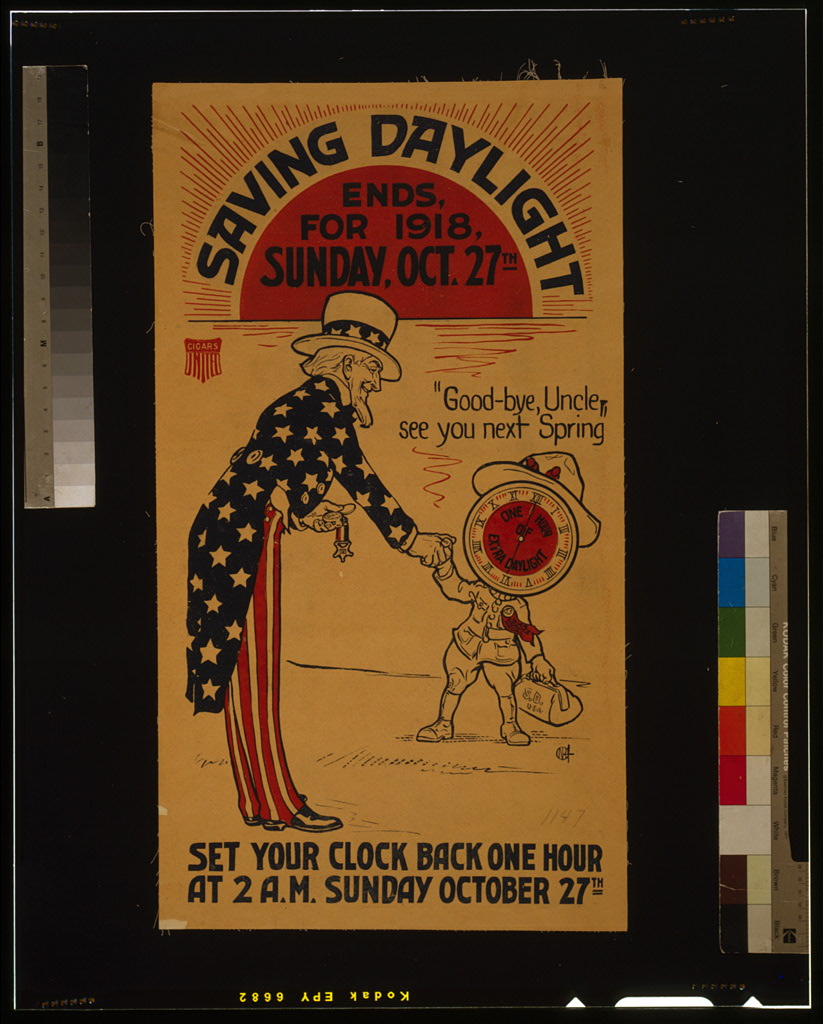
The accompanying Library of Congress poster comes from that first national experiment. It announced the end of daylight saving time on October 27, 1918, and told Americans to set their clocks back one hour at 2 a.m. The basic instruction is nearly identical more than a century later.
War Time returned during World War II
Congress again advanced the nation’s clocks during World War II. Beginning in 1942, year-round daylight saving time became known as War Time. It remained in effect until September 1945.
After the war, federal year-round daylight time ended and local variation returned. Some communities observed daylight saving time while nearby communities did not. Start and end dates could also differ. The result created problems for railroads, airlines, broadcasters and other businesses operating across jurisdictional lines.
The Uniform Time Act created a national schedule
Congress responded with the Uniform Time Act of 1966. It created common starting and ending dates for places choosing to observe daylight saving time. States could exempt themselves, but participating areas had to follow the federal schedule. Responsibility for time-zone boundaries and uniform time observance moved to the newly created United States Department of Transportation.
The original 1966 schedule placed daylight saving time from the last Sunday in April through the last Sunday in October. Congress has changed the dates several times since then.
During the 1973 oil embargo, the United States tried temporary year-round daylight saving time as an energy-conservation measure. The experiment quickly encountered criticism, especially because many children were traveling to school before sunrise during winter. Congress amended the plan in 1974, and the country returned to a seasonal system.
A 1986 law moved the spring starting date to the first Sunday in April. The Energy Policy Act of 2005 expanded daylight saving time again. Beginning in 2007, it started on the second Sunday in March and ended on the first Sunday in November. That remains the federal schedule in 2026.
Energy conservation has repeatedly been used to support daylight saving time, but the measured benefit has been modest. A Department of Energy study of the 2007 extension estimated a reduction of about 0.02 percent in total annual United States electricity consumption. Changes in lighting technology, heating, cooling, travel and household behavior make the effect more complicated than simply counting an extra hour of evening sunlight.
Why some places do not change their clocks
Federal law does not require every state or territory to observe daylight saving time. Hawaii, most of Arizona, American Samoa, Guam, the Northern Mariana Islands, Puerto Rico and the United States Virgin Islands remain on standard time throughout the year. The Navajo Nation, which extends beyond Arizona, does observe daylight saving time.
States may choose to remain on standard time year-round. Under current federal law, however, a state cannot independently establish permanent daylight saving time. A nationwide change to permanent daylight time, or federal permission for states to adopt it, would require action by Congress.
The weather connection
The clock change is not a weather event, but it changes how people experience the seasonal daylight cycle. In early November, the Northern Hemisphere is already losing daylight because of Earth’s axial tilt and its changing position in orbit around the Sun. Returning to standard time makes that gradual astronomical change feel abrupt because sunset suddenly appears about an hour earlier on the clock.
Forecast users should also notice the time-zone abbreviation. A weather bulletin issued in EDT before the transition may be followed by an EST bulletin afterward. Computer systems, phones and many clocks update automatically, but older equipment, vehicle clocks and manually set devices may not.
The darker evening commute can affect visibility for drivers, pedestrians and cyclists. Earlier morning light can help some school and work routines, but sunrise continues becoming later and daylight continues shrinking until the December solstice. The clock change rearranges daylight on the schedule. It does not stop the seasonal loss of daylight.
Congress is again considering permanent daylight saving time
As of November 1, 2026, Congress was again considering whether to end the twice-yearly clock change. The proposal under active consideration would establish permanent daylight saving time, not permanent standard time. Participating time zones would remain one hour ahead throughout the winter instead of returning to their standard-time clocks each November.
The House of Representatives passed H.R. 139, the Sunshine Protection Act of 2025, on July 14, 2026, by a vote of 308 to 117. The bill was received in the Senate the following day, read twice and referred to the Senate Committee on Commerce, Science, and Transportation. A related Senate proposal, S. 29, had been introduced by Florida Senator Rick Scott on January 7, 2025, and referred to the same committee.
Neither proposal had completed the legislative process as of November 1. A bill must pass both chambers in identical form and be signed by the president before it becomes law. Until that happens, the existing schedule remains in effect, with daylight saving time beginning on the second Sunday in March and ending on the first Sunday in November.
Supporters of permanent daylight saving time emphasize later winter sunsets, consistent clocks and more evening daylight for recreation and commerce. Opponents point to later winter sunrises, particularly in northern locations and communities near the western edge of a time zone. Those darker mornings could affect school travel, commuting and outdoor work.
The proposal would not create additional daylight. It would decide whether the available winter daylight appears earlier in the morning or later in the afternoon according to the clock. Because the legislative status can change, readers should consult the latest congressional record for updates.
The useful takeaway
The return to standard time is the modern result of more than a century of transportation needs, wartime policy, local disagreement and federal attempts to create uniform rules. Standard time supplies the basic clock for each time zone. Daylight saving time temporarily advances that clock to place more sunlight in the evening.
The debate continues because no clock arrangement creates more daylight. Permanent standard time favors earlier morning light, while permanent daylight saving time favors later evening light. The choice determines where the available sunlight appears on the clock, not how much sunlight a location receives.
- www.nist.gov ↗
- U.S. Department of Transportation: Uniform Time ↗
- Congressional Research Service: Daylight Saving Time ↗
- Library of Congress: Daylight Saving Time during World War I ↗
- Bureau of Transportation Statistics: History of Time Zones and Daylight Saving Time ↗
- U.S. House Clerk: H.R. 139 vote, July 14, 2026 ↗
- U.S. House: H.R. 139 legislative status ↗
- Congress.gov: S. 29, Sunshine Protection Act of 2025 ↗